
NEWS
Kerry Kennedy, daughter of the late Robert F. Kennedy and niece of President John F. Kennedy, made headlines with a bold vow to remove Donald Trump’s name from the Kennedy Center. After Trump’s name was added to the Center’s exterior during his presidency, Kennedy promised to remove it with “a pickax” once his term ended. Her statement was a response to what she called an inappropriate decision, one that has drawn significant criticism from the Kennedy family and others who argue that the renaming undermines the center’s legacy. Kennedy’s defiant promise highlights the ongoing tensions surrounding Trump’s association with institutions tied to the Kennedy family’s storied legacy

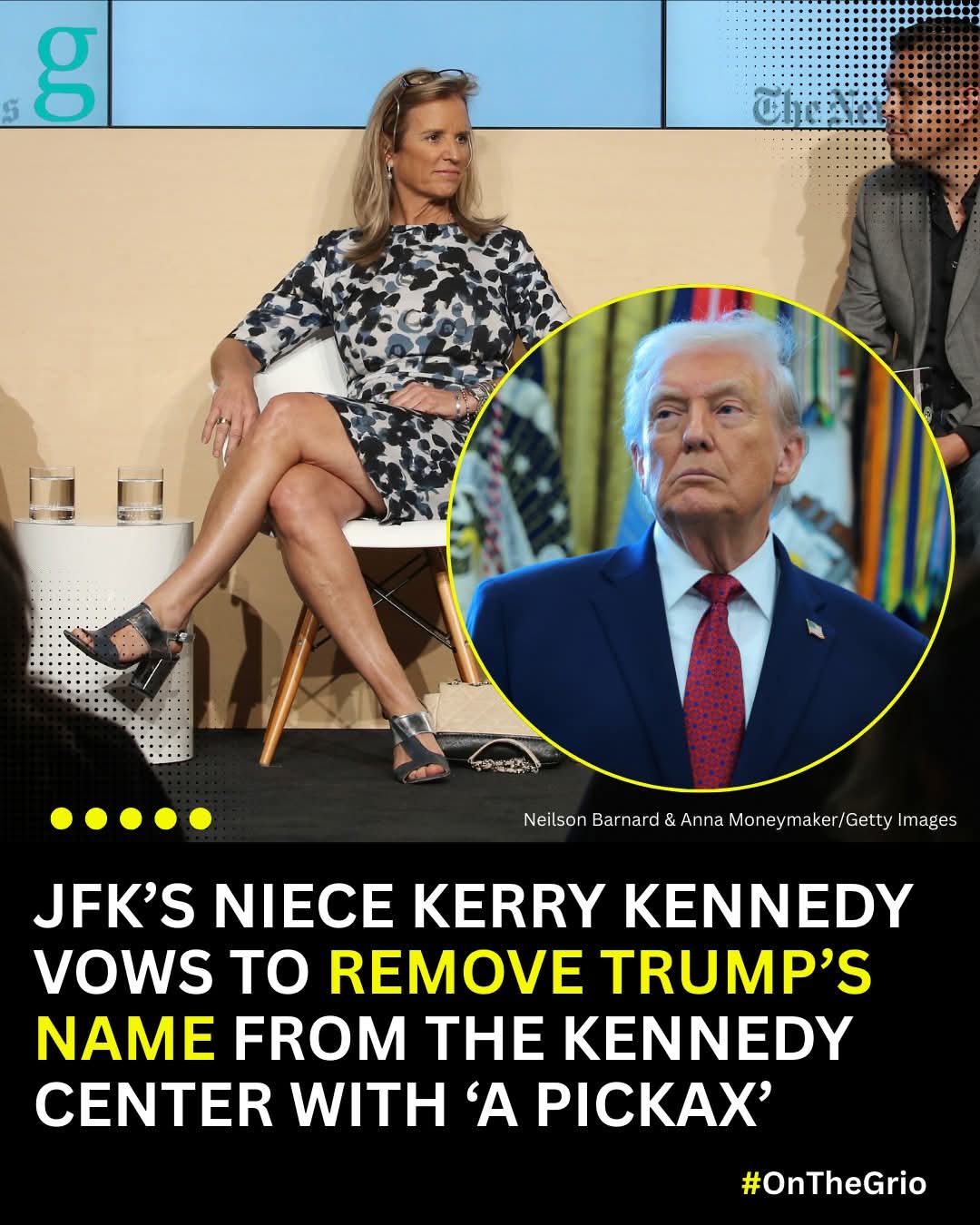
📰 KERRY KENNEDY VOWS TO ERASE TRUMP’S NAME FROM THE KENNEDY CENTER — “I’LL TAKE A PICKAX TO IT”
A new flashpoint has erupted in America’s ongoing culture and political wars — and this time, it strikes at the heart of one of the nation’s most iconic families and cultural institutions.
Kerry Kennedy, daughter of the late Senator Robert F. Kennedy and niece of President John F. Kennedy, has made headlines with a blistering vow:
Donald Trump’s name will not remain on the Kennedy Center — and if necessary, she’ll remove it herself, “with a pickax.”
The statement, both symbolic and incendiary, instantly reignited long-simmering tensions between the Kennedy family and Donald Trump, while reopening a broader debate about legacy, power, and who gets to leave their mark on America’s most revered institutions.
HOW TRUMP’S NAME ENDED UP ON THE KENNEDY CENTER
The John F. Kennedy Center for the Performing Arts was created as a living memorial to the 35th president — a space meant to celebrate culture, creativity, diplomacy, and the arts, values long associated with the Kennedy legacy.
During Donald Trump’s presidency, his name was added to the exterior of the Kennedy Center, a move that surprised many and infuriated others.
Critics argued the decision was made with little public transparency and appeared to politicize an institution historically meant to rise above partisan identity.
For the Kennedy family, the act was not merely controversial — it was deeply personal.
“INAPPROPRIATE” AND “DISRESPECTFUL”
Kerry Kennedy did not mince words.
She called the decision to associate Trump’s name with the Kennedy Center “inappropriate”, arguing it clashed with the institution’s founding mission and her family’s legacy.
Her frustration reflects a wider sentiment shared by several members of the Kennedy family, who have long been vocal critics of Trump’s rhetoric, leadership style, and treatment of democratic norms.
To them, the Kennedy Center is not a branding opportunity — it is a symbol.
A symbol of postwar optimism.
Of cultural diplomacy.
Of a presidency remembered for expanding the arts, not attacking institutions.
THE PICKAX COMMENT — SYMBOLISM WITH TEETH
When Kennedy said she would remove Trump’s name “with a pickax,” it was not a literal construction plan — it was a statement of defiance.
The image was powerful: A descendant of America’s most famous political dynasty standing ready to physically dismantle what she views as a violation of her family’s legacy.
The remark spread quickly across media and social platforms, praised by Trump critics as a bold stand and condemned by supporters as theatrical hostility.
But symbolism matters in American politics — and Kennedy knew exactly what she was doing.
A FAMILY FEUD ROOTED IN VALUES
This clash is not new.
The Kennedy family and Donald Trump represent two vastly different visions of American leadership.
The Kennedys have long emphasized: • Multilateralism
• Cultural engagement
• Civil rights
• Institutional respect
Trump’s presidency, by contrast, was defined by: • Open conflict with cultural institutions
• Skepticism toward elite norms
• Rejection of legacy politics
• Personal branding within public spaces
To many Kennedy family members, Trump’s name on the Kennedy Center feels less like recognition and more like appropriation.
THE WIDER DEBATE: WHO OWNS AMERICAN INSTITUTIONS?
Beyond the family drama lies a deeper question:
Who gets to shape the identity of America’s cultural landmarks?
Should sitting presidents imprint their names on institutions tied to historical legacies?
Where is the line between honor and politicization?
And once power changes hands, should those imprints remain?
The Kennedy Center controversy exposes how even art spaces are no longer immune from political battles — they have become symbolic territory in a broader struggle over history and memory.
TRUMP, SYMBOLISM, AND PERMANENCE
Donald Trump has consistently understood the power of naming, branding, and physical presence. From skyscrapers to golf courses to public buildings, his name is his signature.
But public institutions are not private properties — and that distinction is at the heart of this conflict.
Kennedy’s vow suggests that Trump’s presence at the Kennedy Center was never permanent — only tolerated by circumstance.
And now, with that circumstance gone, the reckoning has arrived.
WHAT HAPPENS NEXT?
Whether Trump’s name is formally removed through administrative action or becomes the subject of prolonged public debate, one thing is clear:
This fight is about more than a sign on a wall.
It is about: • How legacies are protected
• How power is remembered
• And whether cultural institutions can remain above political conquest
For Kerry Kennedy, the answer is simple:
The Kennedy Center should reflect the values of its namesake — not the ambitions of a later president.
And if it doesn’t?
She’s made it clear she’s not backing down.
A national pro-life organization has endorsed Rep. Ralph Norman in South Carolina’s closely watched Senate primary to replace the late Sen. Lindsey Graham. MORE:
Trump Touts Crime Record in N.Y. as GOP Midterm Races Heat UpTrump Touts Crime Record in N.Y. as GOP Midterm Races Heat Up
OMG!! Taylor Swift and Travis Kelce Finally Confirm That… See Full Details
Inside the 10-Minute Clip That Has Everyone Crying: The Kelce Girls’ Heartfelt Wedding Performance, Wyatt, Elliotte, and Bennett Serve as Flower Girls and Perform a Special Song They Composed for Taylor Swift and Travis Kelce at their Star-Studded Wedding, Our Girls Stole the Show!’ Jason Kelce’s Wife Kylie Kelce Shares Precious Wedding Pictures as Her Daughters See the Never-Before-Seen 10-Minute Clip and 20 Newly Released Wedding Photos..,⤵️⤵️
JUST IN…:A somber and emotional moment unfolded today as the President of the United States, visibly shaken, fought back tears while addressing the nation about devastating news concerning his wife, Melania Trump. The heartbreaking announcement came during a last-minute press conference at the White House, leaving reporters and the gathered crowd in stunned silence…SEE the Emotional Heartbreaking Announcement
First Look at the Moment Travis Kelce Spots Taylor Swift Arriving With Her Mom Andrea and His Mom Donna Kelce and CHARGES OVER to Rush and Kiss Her moments afer she was rushed to the ………….. see details below
Kylie Kelce Finally Addresses and confirmed Baby No. 5…. Her Response Says It All
